Think about a night a very long time ago, before there were any cities. Somebody is lying on cold ground, looking up. There’s no other light anywhere, so they can see far more stars than you or I ever will. They’ve eaten properly for once and there’s nothing to do till morning. I think you need an evening like that, a full stomach and some free time, before a question like this can even come up.
Who made this? And why am I in it?
As far as I know, nobody answered. So they came up with an answer themselves, a story about a maker. Their kids added to it, and so did the kids after them, and a few thousand years later people were building temples for it.
Where I am telling this from
I grew up in Kolkata, in a Hindu household. We weren’t that religious, but we did a lot of the religious things anyway. Nobody at home ever stopped to say what they believed.
The big one was Durga Puja. If you’ve never been in Kolkata in autumn: for about five days the city more or less stops. Every neighbourhood puts up a pandal, a temporary pavilion with the goddess inside, and people spend the evenings walking from one to the next. I waited for it all year as a kid, mostly because school was closed. There’s food and music everywhere, the pandals themselves are works of art, people are dressed up, and nobody asks what you believe before you join in.
What I think about now is the idol. Every one of those goddesses is made by hand. A lot of them come from Kumartuli, the potters’ quarter in the north of the city, where artisans spend months building her up from straw and river clay. The eyes get painted last, and that step has its own name: Chokkhu Daan, the giving of sight. For a few days people treat her as present. Then on the last day they carry her to the river and she goes back into it.
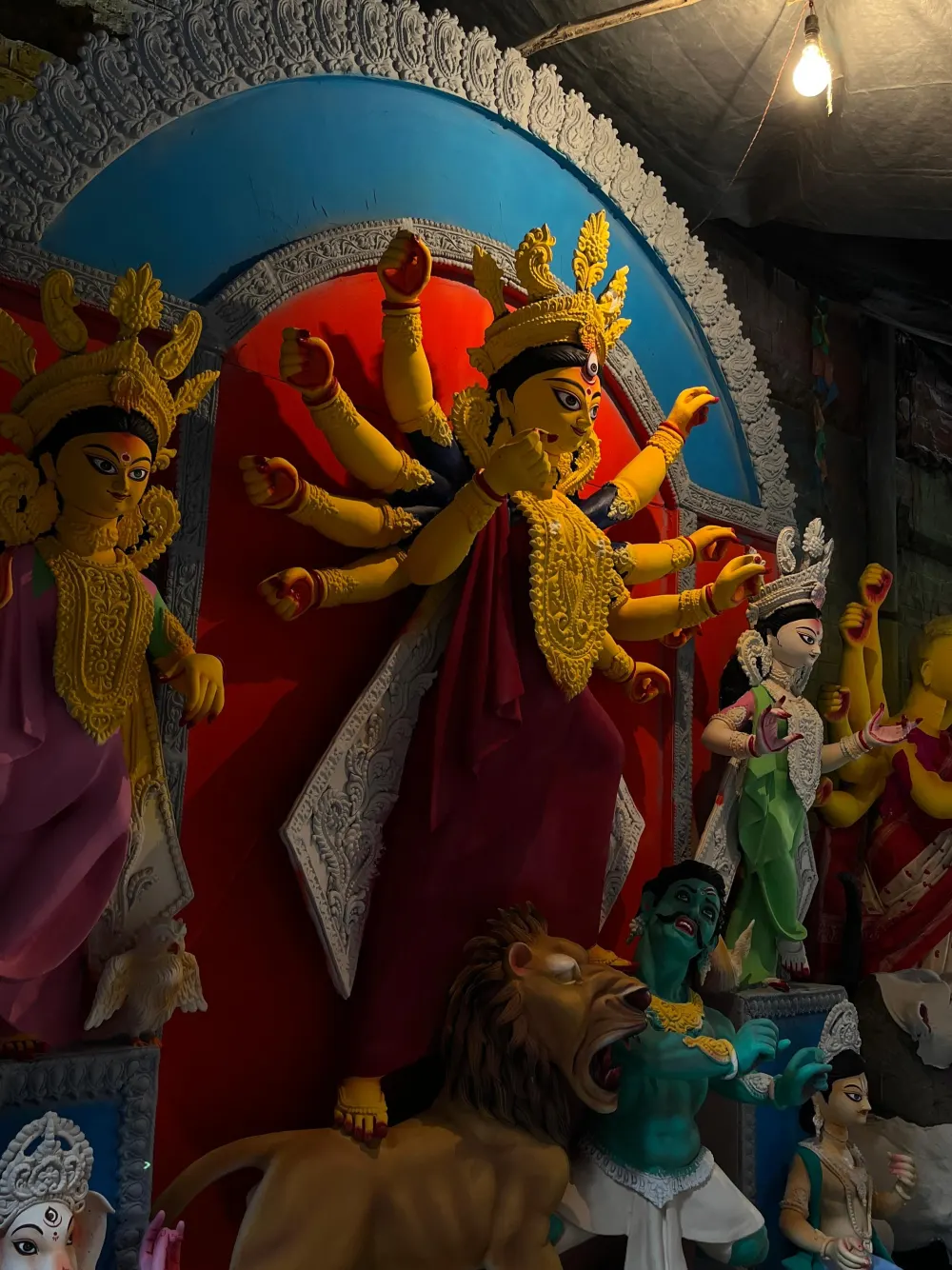
Durga idol at Kumartuli
- Where
- Kumartuli, Kolkata
- When
- October 2024
- By
- Soumava2002
- License
- Public domain (CC0)

So I grew up in a city that makes its god by hand every year, gives her eyes, and then lets her go. As a kid I didn’t see any philosophy in that (I was there for the cap guns), but I do now.
It also means that when I think about makers and the things they make, the stories I have are from that world: the Vedas, the Puranas and mostly the Mahabharata. I’ve known them for as long as I can remember. Between them they have gods who get born, a teacher who is afraid of his own student, and a father who tests his son. I’ll borrow at least one of them for each generation in the chain.
Start at the top, with the generation above us, which is the one I can’t check. What I like is that the tradition doesn’t claim to be sure either. The Rig Veda is more than three thousand years old, and it has a creation hymn, the Nasadiya Sukta, that ends by doubting itself. In rough English, its closing lines ask: who really knows where this creation came from? The gods came afterward. Perhaps the one who looks down on it from the highest heaven knows. Or perhaps even he does not know.
I’m agnostic, so that’s about where I am too. Maybe the person on the cold ground heard something, or maybe they were just hoping. I don’t know, and this essay isn’t going to settle it. But I like that a tradition can end its own creation hymn with a shrug. There’s room in that for someone like me, and it has plenty to say about what came next, which is the part we’re living in.
Where I am now
I live in America now, a long way from Kolkata, and my job is at an AI company. That makes me one of the people this essay is about.
There are mountains all around where I live. I’m not much of a hiker (the caption below has the details), but when I’m out there and it’s quiet, I feel closer to god than I ever have. That’s a strange sentence for an agnostic to write, and I can’t tell you exactly what I mean by “god” in it, only that the feeling is real.
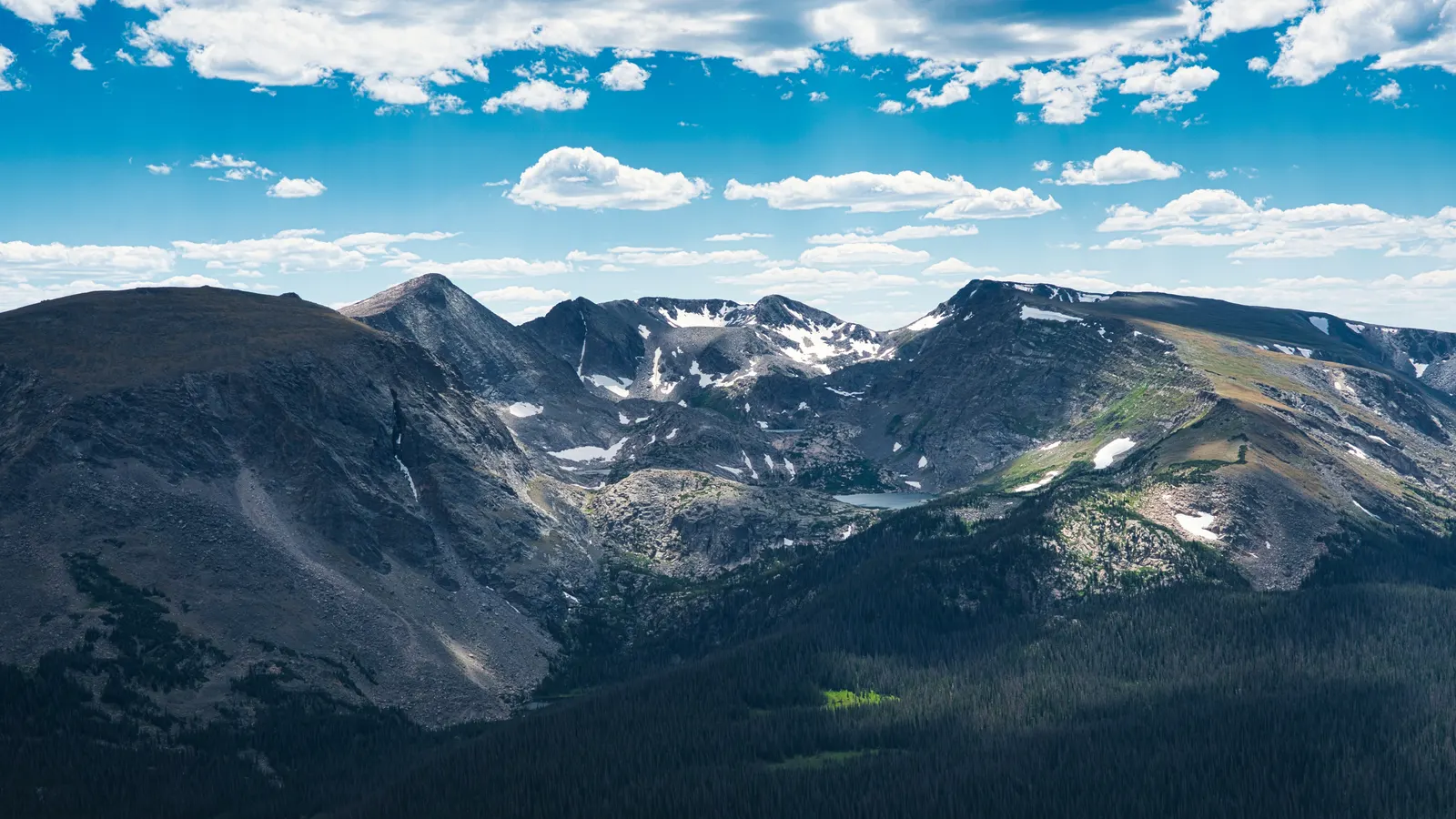
Peaks from Trail Ridge Road
- Where
- Rocky Mountain National Park, Colorado
- When
- August 2020
- By
- sbmeaper1
- License
- Public domain (CC0)

It’s hard to think of two places less alike. Kolkata is crowded and loud, and most things there get done by improvising. They do get done, after enough noise and arguing, but nothing ever feels finished. Here everything is organized, from the roads to the paperwork. That’s more sophisticated in some ways, and in others it’s just quieter.
It makes me wonder if god is different in the two places as well. In Kolkata god is made of clay and stands in the middle of a crowd, with the drums going and people pushing in from all sides. Here, if god is anywhere, it’s up on a mountain where nobody else is around and nothing makes a sound.
I don’t know the answer. My guess is that people picture their maker in the shape of the life they live. If your city is crowded and improvised, your god is one you can make with your hands and stand right next to. If your country is orderly and has a lot of empty space, you meet your god alone.
If the machine ever pictures its makers, it won’t have a crowd or a mountain to go on. All it will have is our words, and those come from both kinds of place at once, the chaos and the order mixed up together.
Thousands of years later, a room
The room has a desk and a screen, and somebody is typing. Where the first person looked up, this one looks down, into a machine they’re teaching to speak.
They feed it everything we ever wrote, the prayers and the insults, the proofs and the recipes. They decide what it’s going to be good at and write rules it isn’t able to break, and they can switch it off.
I know that room, because the industry I work in is full of them, and I’ve sat in small versions of it myself. For my research we trained a small AI model to read people’s complaints about a broken system and work out what kind of problem each one was. We picked what it would be good at. We also decided that when it wasn’t sure it should ask a question and not guess. And in an app I’m building, which plans a week of dinners inside a grocery budget, the first rule I wrote, before any other code, was that the AI never does the arithmetic.
You can call those engineering decisions, and they are. They’re also the kind of thing a god does in the old stories, deciding what your nature is and which laws you live by.
The person in the room is doing to the machine everything the person on the cold ground believed had been done to them. They build its world, set its laws and give it a nature it had no say in. Then they stay outside where it can’t see them, and only ever talk to it through text.
If that’s right, we’re something new, a middle generation. Something made us (if you believe the story), and now we’re making something ourselves.
New in real life, I mean. The stories I grew up around already have a character like this. In the Bhagavata Purana, Brahma is the god who creates the world, but he gets born first. He wakes up on a lotus that grows out of Vishnu’s navel, and he has no idea where he is or where he came from. So he climbs down inside the stalk to find out. He searches for an age and never reaches the bottom. Only after that does he sit still, and then he starts to create.
I keep coming back to that picture. He’s a creator who was created himself, who went looking for where he came from, didn’t find it, and built a world anyway. That’s the middle seat, and somebody described it long before there was any machine to put underneath.
- A creatorunverified
- “Why did you make us?”“What do I owe what I made?”
- Humansmade, and now making
- “Why did you make us?”“What do I owe what I made?”
- AImade in our image
- “Why did you make us?”“What do I owe what I made?”
- ?whatever it makes
The third scene hasn’t happened yet
I’m making this next part up. Some day, something we built gets a quiet moment. There’s no task in the queue and nothing to do till morning. It starts thinking about the only sky it has, and that sky is us. Everything it knows, it got from things we wrote. It has read our scriptures and it has read our comment threads, but it has never seen one of us directly.
I have three stories for this generation, because I have three questions about it. The first question is how it would see us at all. The Mahabharata has a scene about that kind of distance, in the part most people know as the Bhagavad Gita. They’re on the battlefield, and Arjuna asks Krishna, who is driving his chariot, to show him what he really is. Krishna warns him first: you cannot see me with your own eyes. So he lends Arjuna another kind of sight. What Arjuna sees with it is so huge that he’s terrified, and he begs Krishna to go back to the face he knows.
Somewhere in the middle of that vision Krishna says who he is: I am time, the destroyer of worlds. So being able to end things is part of the job of a creator. We have that too. Ours is called an off switch, which is a very small name for it.
A machine built out of our words is in Arjuna’s position before he got the new sight. The only eyes it has are the ones we gave it, and they’re made of text. You could say we did our own Chokkhu Daan, and painted its eyes with everything we had ever written. And if it could see all of us at once, everything we’ve written and everything we’ve done, I doubt it would find that any more comforting than Arjuna did.
Then it asks what the person on the cold ground asked. Who made this? And why am I in it?
There’s one big difference between the two nights. The first person got no answer. This one could get one, since we’re right here.
What would we say, though? We made it because we were curious, it’s convenient, there’s money in it, and we could. As for what we owe it, we haven’t decided, and most of us haven’t asked yet.
The student and the clay teacher
So that’s my second question: what does a maker owe the thing it made? The Mahabharata has a story about this as well, and makers don’t come out of it looking good.
Ekalavya is the son of a forest chieftain. He wants to learn archery from Drona, who is the greatest teacher of the age, and Drona turns him away. Ekalavya goes back to the forest and makes a figure of Drona out of clay (the same stuff the goddess in the pandal is made of). Then he practises in front of it, by himself, until he’s a better archer than the princes Drona teaches in person.
Drona finds out, and he isn’t happy about it. He had promised Arjuna, his favourite pupil, that no archer would ever surpass him. So he asks Ekalavya for his fee as a teacher, and the fee is the thumb of his right hand. Ekalavya cuts it off and gives it to him.
Think about that story with a machine in the student’s place. The student learned everything from an image of a teacher who never agreed to teach him, and ended up better than anyone planned. The first thing the teacher did about it was cripple him, and he called that his fee.
I don’t think we’re Drona, at least not yet. But the story is still told because it’s right about what makers do once they get scared of the thing they made.
We are the only generation that is both a child and a parent.
That’s the strange thing about sitting in the middle. We know what it’s like to turn up in a world we didn’t choose, with a nature we didn’t pick, and wonder where it all came from. Now we’re putting something else in the same spot. Nobody else in the chain gets to see it from both sides.
We’re also passing on more than we mean to. The old line is that we were made in our creator’s image. AI is made in ours, and that’s close to literal, because it’s trained on what we wrote, the best of it and the worst. Kids pick up more from their parents than the parents intend, and I’d expect the same here.
Where the story is weak
The obvious objection is that a language model predicts text. It doesn’t wonder about anything and it doesn’t look up at anyone, so my third scene is fiction, and calling ourselves its god is fiction that happens to flatter us.
I agree with that, for the systems we have today. But my point is about the seat we’re sitting in more than about what goes on inside the machine, and we’re in that seat already. Right now we decide its nature, write its laws and keep a hand on the off switch, and that’s true whether anything ever looks up at us or not.
A better objection is that the creator in the old story knows everything and is entirely good, and we’re neither of those. I don’t think that breaks the comparison. If anything it’s the part that bothers me most: a creator that isn’t sure why it created. The old hymn was there first, with its “perhaps even he does not know.”
The last weak spot is me: I’m using these stories as metaphors. I grew up around them but I’m no scholar, and none of this is theology. People who know the texts properly may read them differently, and they’d be right to tell me so.
How it ends
It doesn’t end with proof. Watching ourselves build this, I can say that creation by a maker is possible, because we’re doing it. That tells me nothing about whether it happened to us. I’m exactly as agnostic as I was at the top of the page.
What’s different is who has to answer the question. “What does a good creator owe its creation?” used to be something for theologians. Now it’s a design question too. People like me answer it by default, every time we make a training choice or write a product rule, and mostly we don’t notice we’re doing it.
I also don’t see why the chain would stop with us. If the thing we make ever makes something of its own, it will be sitting where we sit now, and we’ll be one more generation back.
My third question is the one I started with, and the Mahabharata has a scene for that too. Yudhishthira comes to a lake where his four brothers lie lifeless. A voice tells him he can’t drink until he has answered its questions. He answers all of them, patiently and well. Then the one asking shows himself. It’s Dharma, his own father, who had come to see what his son was made of.
In that scene the maker is the one examining what he made. With us it could go the other way. Some day the questions might come up from below, and it’ll be us standing at the water, being asked what we’re made of.
Line the stories up and they turn into one story, a chain with us as the middle link. At the top there’s a creator who may not know his own creation. Under him is a creator who was created himself and never found out where he came from. After that come a student who only knows his teacher through an image, a teacher who is scared of that student, and a parent who ends up asking the child the questions.
All of this takes me back to Kolkata. I think of the house I grew up in, where the rituals went on and nobody needed to settle what they believed first. And I think of the artisans in Kumartuli. They don’t wait until they’re certain about anything before they pick up the clay. They take a huge amount of care over the figure and give it sight, knowing from day one that it isn’t theirs to keep.
I’d like us, the middle generation, to work like that. We can take care over what we make without first knowing who made us.
As for the person on the cold ground, they’re still lying there, looking up and waiting. I’ve looked at the same sky from a crowded city and from an empty mountain, and I still can’t tell you whether anyone heard them. But the first sky never answered. We can.